
History & Heritage
Mehrgarh: Where Farming Began in the Bolan Foothills
Contributed by Zoleikha Baloch · October 17, 2026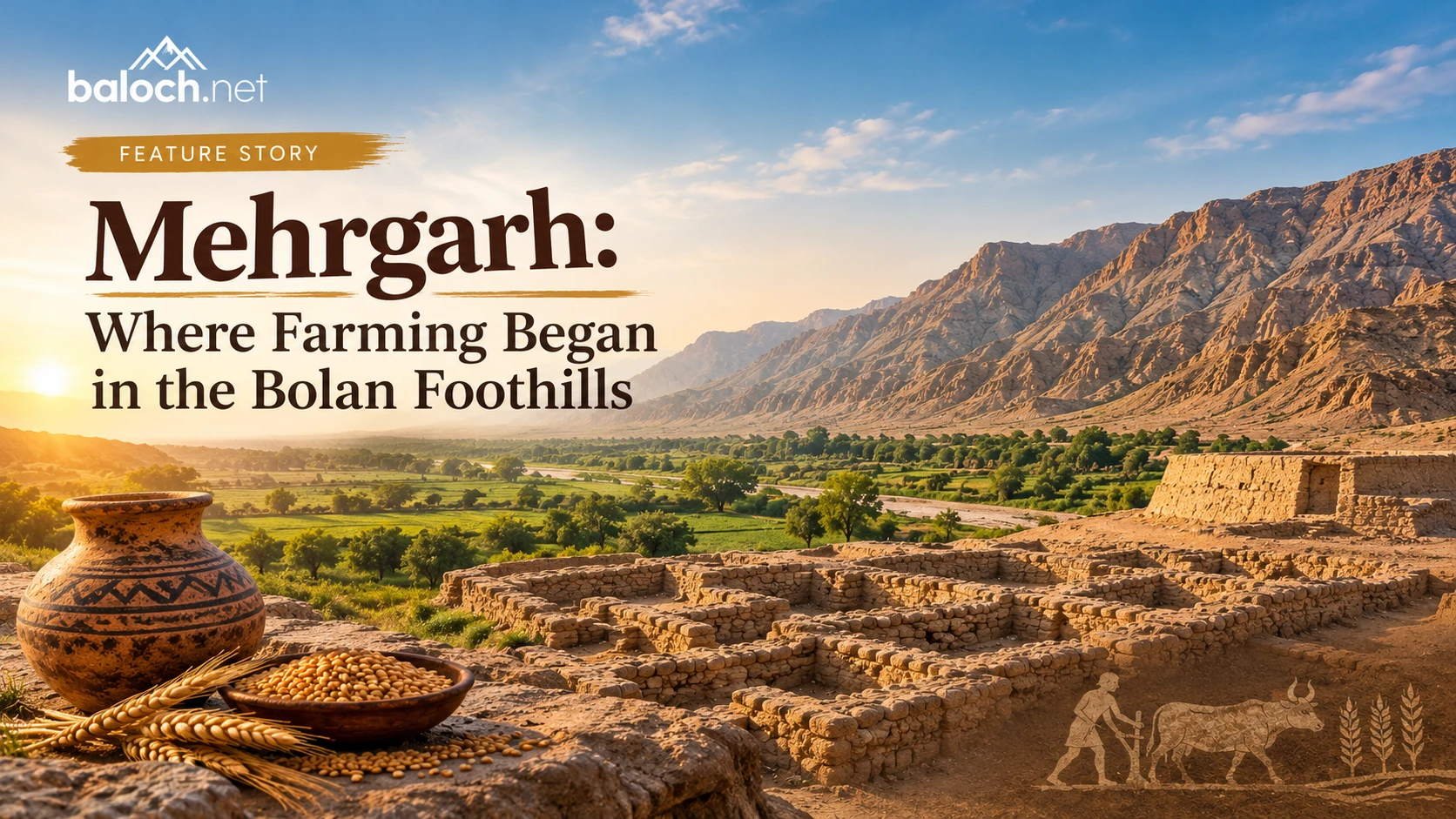
Long before there were cities on the Indus plains, before writing, and before pottery, a village stood where the Bolan River leaves the mountains. Its people built mud-brick houses, stored grain, herded animals and, as the evidence shows, even drilled their own teeth. Today the place is called Mehrgarh. It lies in Balochistan, about 130 km from Quetta, on the Kacchi Plain.
A Village at the Mountain Gate
Mehrgarh sits near the mouth of the Bolan Pass, one of the oldest routes between the highlands and the plains. A French archaeological team led by Jean-François Jarrige began excavating here in the 1970s, and what they found changed how the region is understood. Jarrige argued that this part of South Asia was no backwater of the ancient Near East. Farming communities were taking root here very early.
Life 9,000 Years Ago
The oldest layers date from before 7000 BCE, a Neolithic phase in which people did not yet make pottery. The first settlers hunted, but they also harvested wild barley in large quantities. Over time the village grew into a community of farmers and herders with granaries to store their harvest, a sign of planning and shared effort. Pottery appears later, in the centuries that follow.
Think about what that means. This was not a camp. It was a settled place, with homes, stored food and a calendar built around planting and harvest, thousands of years before the great cities of the Indus Civilization.
The Oldest Dentists
The most surprising discovery at Mehrgarh is also the most human. Archaeologists found teeth that had been drilled, evidence of dentistry dated to roughly 7,000 to 9,000 years ago. The people of Mehrgarh, it seems, were using tiny stone drills to treat dental problems. For many visitors, this is the detail they remember most.
What Happened Next
Mehrgarh was occupied for thousands of years, and nearby settlements such as Nausharo continued the story. Some researchers suggest that as the climate grew drier, people moved toward the Indus plains, where the great cities of the Indus Civilization later rose. The exact path is still debated, but the connection between Mehrgarh and what came after is one of the most important questions in South Asian archaeology.
Why It Matters Today
It is important to be careful here. Mehrgarh belongs to a time long before any people we could call Baloch were recorded, and no one should claim a direct line from its villagers to anyone alive today. What is certain is that Mehrgarh is part of the heritage of this land. Balochistan is known for its mountains, its coast and its culture, but it is also the home of one of the earliest farming settlements in South Asia.
That heritage needs protection. The Express Tribune has reported that the site needs to be preserved, and a place that has survived nine thousand years should not be lost to neglect. If you visit, treat it with care, take photographs and leave nothing behind.
Share your story: have you visited Mehrgarh, or do you have photographs or family stories connected to the Bolan region? Send them to us at baloch.net/contribute and we will gladly preserve them in our gallery.
Sources: Mehrgarh (Wikipedia); Express Tribune, "9000-year-old Mehrgarh needs to be preserved"; Yale eHRAF Archaeology, Mehrgarh documents; The Collector, article on Mehrgarh.
A Village at the Mountain Gate
Mehrgarh sits near the mouth of the Bolan Pass, one of the oldest routes between the highlands and the plains. A French archaeological team led by Jean-François Jarrige began excavating here in the 1970s, and what they found changed how the region is understood. Jarrige argued that this part of South Asia was no backwater of the ancient Near East. Farming communities were taking root here very early.
Life 9,000 Years Ago
The oldest layers date from before 7000 BCE, a Neolithic phase in which people did not yet make pottery. The first settlers hunted, but they also harvested wild barley in large quantities. Over time the village grew into a community of farmers and herders with granaries to store their harvest, a sign of planning and shared effort. Pottery appears later, in the centuries that follow.
Think about what that means. This was not a camp. It was a settled place, with homes, stored food and a calendar built around planting and harvest, thousands of years before the great cities of the Indus Civilization.
The Oldest Dentists
The most surprising discovery at Mehrgarh is also the most human. Archaeologists found teeth that had been drilled, evidence of dentistry dated to roughly 7,000 to 9,000 years ago. The people of Mehrgarh, it seems, were using tiny stone drills to treat dental problems. For many visitors, this is the detail they remember most.
What Happened Next
Mehrgarh was occupied for thousands of years, and nearby settlements such as Nausharo continued the story. Some researchers suggest that as the climate grew drier, people moved toward the Indus plains, where the great cities of the Indus Civilization later rose. The exact path is still debated, but the connection between Mehrgarh and what came after is one of the most important questions in South Asian archaeology.
Why It Matters Today
It is important to be careful here. Mehrgarh belongs to a time long before any people we could call Baloch were recorded, and no one should claim a direct line from its villagers to anyone alive today. What is certain is that Mehrgarh is part of the heritage of this land. Balochistan is known for its mountains, its coast and its culture, but it is also the home of one of the earliest farming settlements in South Asia.
That heritage needs protection. The Express Tribune has reported that the site needs to be preserved, and a place that has survived nine thousand years should not be lost to neglect. If you visit, treat it with care, take photographs and leave nothing behind.
Share your story: have you visited Mehrgarh, or do you have photographs or family stories connected to the Bolan region? Send them to us at baloch.net/contribute and we will gladly preserve them in our gallery.
Sources: Mehrgarh (Wikipedia); Express Tribune, "9000-year-old Mehrgarh needs to be preserved"; Yale eHRAF Archaeology, Mehrgarh documents; The Collector, article on Mehrgarh.